
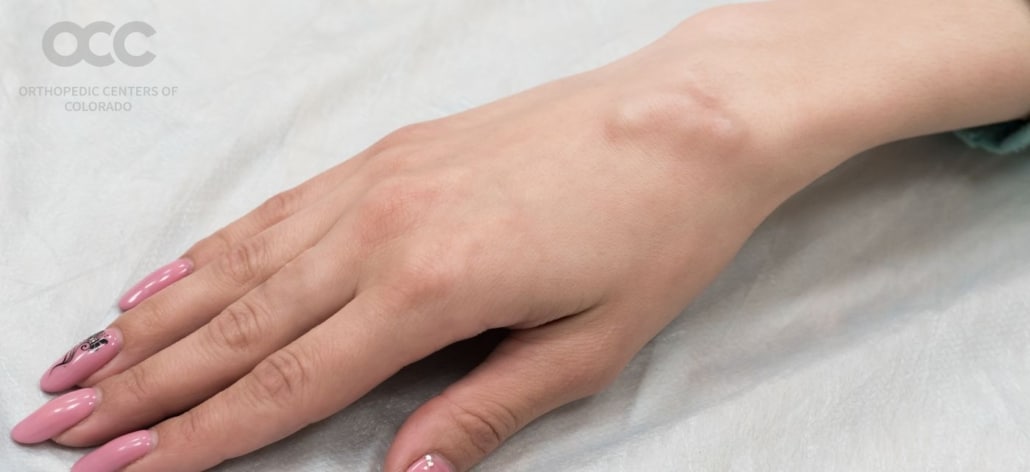
Ganglion Cyst
/in Hand & Wrist, NewsGanglion cysts are a common condition that few people know about. Ganglion cysts occur in 70% of people between the ages of 20-40 and are more common in women. When people hear the word “cyst”, what often comes to mind is “tumor.” It can be scary to find a strange lump anywhere on the body. Ganglion cysts are often painless, requiring no treatment, but ignoring them might lead to complications. This is why it’s so important to get a diagnostic consultation with the skilled and experienced orthopedic specialists at the Colorado Center of Orthopaedic Excellence in Colorado Springs, Colorado. A ganglion cyst might only require a wait-and-watch approach, but you need experts to do it.
WHAT ARE CYSTS?
In general terms, a cyst is a sac-like pocket of membranous tissue that contains a thick, sticky, clear, colorless, jellylike material. A hundred types of cysts can originate anywhere on the body or under the skin.
GANGLION CYSTS
Ganglion cysts are also called Bible cysts or Bible bumps because a common home remedy in the past was hitting the cyst with a Bible or other thick book to make the cyst rupture or pop. 60 to 70 percent of ganglion cysts develop on the front or back of the wrist. Other areas, but less common are at the base of the fingers, on the palm, the fingertip, just below the cuticle, the outside of the knee and ankle, and the top of the foot. Ganglion cysts can range in size. They can be as small as a pea or as large as a golf ball. Some ganglion cysts are visible under the skin, but others are so small that they can’t be seen. The size of a ganglion cyst can fluctuate, often getting larger when you use that joint for repetitive motions. Unlike benign tumors, ganglion cysts are not cancerous, nor can become cancerous.
WHAT CAUSES GANGLION CYSTS?
No one knows exactly what causes a ganglion cyst to develop. It grows out of a joint or the lining of a tendon, looking like a tiny water balloon on a stalk. It seems to occur when the tissue surrounding a joint or a tendon bulges out of place. Factors that may increase the risk of ganglion cysts include:
- Sex and age. Ganglion cysts can develop in anyone, but they most commonly occur in women between the ages of 20 and 40.
- Osteoarthritis. People with wear-and-tear arthritis in the finger joints closest to their fingernails are at higher risk of developing ganglion cysts near those joints. Joint or tendon injury. Joints or tendons that have been injured in the past are more likely to develop ganglion cysts.
- They sometimes are found in people who do sports or other activities that require them to put pressure on their wrists.
SYMPTOMS
Most ganglion cysts don’t cause symptoms or interfere with function in any way, but things to look for can include:
- A soft bump or mass that changes size but doesn’t move
- Swelling that may appear over time or suddenly
- It may get smaller in size or even go away and come back
- One large cyst or many smaller ones may develop, but they are usually connected by deeper tissue
- Some degree of pain is possible, especially after acute or repetitive trauma, but many ganglion cysts aren’t painful
- Pain may be chronic and get worse with joint movement
- When the cyst is connected to a tendon, there can be a sense of weakness in the affected finger
- If the cyst is on the foot or ankle, there may be discomfort or pain, especially wearing shoes
- If the cyst is near a nerve, it can cause a loss of mobility, numbness, or tingling sensation
HOW GANGLION CYSTS ARE TREATED
Some ganglion cysts go away independently, while others remain small and cause no problems. Small cysts may just be monitored, requiring no treatment at all. If a larger cyst is causing discomfort, your doctor may recommend over-the-counter medications such as acetaminophen (Tylenol), naproxen (Aleve, Naprosyn), or ibuprofen (Advil, Motrin). Regular use of warm compresses may increase blood circulation and promote fluid drainage. They will, however, not prevent cyst growth. Avoiding repetitive wrist and hand movements can relieve discomfort. If the cyst is painless, the doctor might take an observational approach, which means leaving it alone to see what happens. If the cyst is hampering movement or other treatments, don’t relieve pain, wearing a splint to immobilize the affected area can relieve stress, provide pain relief and sometimes even lead to a decrease in the size of the cyst. Aspiration is another treatment option. With this procedure, a needle is placed into the cyst to draw the liquid material out. Then a steroid compound (anti-inflammatory) is injected into the area, and the area is put in a splint to keep it from moving. Aspiration doesn’t remove the area that attaches the cyst to the joint, so they often return.
WHEN IS SURGERY INDICATED?
Surgery is usually seen as a last resort for ganglion cyst treatment. Surgery involves making a small incision to remove the ganglion cyst and part of its “root,” which is the part of the cyst that connects it to the joint or tendon sheath. Surgery is performed using regional anesthesia and does not require an overnight stay in the hospital. There could be some soreness and swelling at your incision site for a few days. Most patients feel much better within the first few days, but it takes two to six weeks to recover fully.
GETTING THE RIGHT DIAGNOSIS
Any bump isn’t something to be ignored. But because it could be from anything, getting the right diagnosis is necessary to determine the right treatment. In assessing a ganglion cyst, the doctor will take note of the lump’s location, how it feels to the touch, and what it looks like. Ganglion cysts are translucent, so part of the diagnosis may be shining a light on the cyst to see if the light shines through it. An X-ray can determine whether there are problems in nearby joints. Your doctor may get further confirmation by using a syringe to draw out some of the fluid in the cyst. Sometimes, an MRI can show a ganglion cyst that is not visible on an X-ray. An ultrasound may be used to determine whether the bump is fluid-filled (cystic) or if it is solid. An ultrasound can also detect whether an artery or blood vessel is causing the lump. At the Colorado Center of Orthopaedic Excellence in Colorado Springs, Colorado, you can feel confident that the right diagnosis and the right care will get you on the right path to eliminating a ganglion cyst, helping you get back to a life free of pain and discomfort.